


Apex Chronicles: Foundations Built, Horizons Ahead
Part 7 of the Apex Engine Retrospective Series
Over the last 8 weeks, this journey has brought us down memory lane through 2025, where prototypes began turning into foundations.
Looking back across 7 years, the lesson is simple. Planning matters. No plan survives unchanged, but a good one creates enough structure to adapt. Each year brought technical and operational surprises that reshaped the roadmap. Progress continued because the foundation prioritized resilience.
Progress often felt slow during legacy rebuilds and deep architectural cleanup. In hindsight, those were the most productive years. They forced clarity, exposed assumptions, and replaced improvisation with intent. Architecture strengthened, processes matured, and planning became a stabilizer.
What began as an effort to stabilize and extend legacy technology evolved into a full architectural reinvention. These years were marked by deep technical work, unexpected detours, security challenges, and hard-earned lessons that reshaped how the company approaches engineering, planning, and resilience.
Top 7 Goals (Across 2019–2025)
1. Establish clean corporate structure & architecture
2. Update systems inherited from legacy environments
3. Rebuild The Repopulation to identify future needs
4. Evolve HE3/P3D into what becomes Apex Engine
5. Strengthen business through strategic planning
6. Build prototypes validating real-time systems
7. Move from concept to a scalable platform
Top 7 Difficulties
1. Inherited technical debt & missing documentation
2. Inconsistent external clients & missed commitments
3. Financial strain from unpaid work & shifting scopes
4. Client delays & communication issues
5. Friction between legacy & modern constraints
6. Security incidents, hijacking, & interference
7. Logistical strain of building with limited resources
Top 7 Mitigations
1. Full code audits to expose hidden instability
2. Rebuilding critical systems instead of patching
3. Creating internal environments & workflows
4. Writing internal documentation to unify planning
5. Pivot based on data, not assumptions
6. Prioritize R&D across multiple disciplines
7. Treat setbacks as diagnostics to improve architecture
Top 7 Successes
1. Defined the architectural backbone of Apex Engine
2. Modernized rendering, AI, & tools through iteration
3. Turned The Repopulation rebuild into an engine blueprint
4. Established clear principles focused on stability & scale
5. Built prototypes validating long-term platform direction
6. Strengthened the company through discipline & resilience
7. Created a platform evolving by intent, not accident
“In tech, resilience is the ultimate feature. Everything else is just version control.”
Building Engines Is About Endurance
 Across both HeroEngine and Apex Engine, one lesson consistently resurfaced. Building an engine is not just about code. It is about endurance, clarity, and choosing the long game year after year. Technology can be rewritten. Systems can be refactored. Tools can be rebuilt. What cannot be shortcut is persistence through uncertainty.
Looking back from 2025, the throughline is clear. Every year mattered more than it seemed at the time. Progress was not always visible, but it was cumulative. What survived did so because it was built with intent rather than convenience.
2019: Parameters, Planning, and Redirection
From the outside, 2019 appeared quiet. Internally, it was a structural reset. The year was spent inside planning documents, architectural debates, and early sketches that would later define Apex Engine’s collaborative workflows and simulation layers. Nearly all of the work was invisible, but everything that followed depended on decisions made during this period.
This was the year TGS Tech recognized that the future of real-time development would not come from extending an aging foundation. It required rethinking the system entirely. The work done in 2019 established the parameters for every major decision that followed. Without that clarity, the next six years would have collapsed under their own complexity.
The company focused on establishing a clean corporate foundation in Maryland, pivoting away from legacy constraints, and re-evaluating the architectural direction behind HeroEngine. Early concepts for what were then called HE3 and P3D began to take shape. These prototypes would eventually evolve into Apex Engine.
Slow architectural progress defined the year. It was a reminder that stability often comes from restraint, and that initial conditions matter. When those conditions are wrong, the cost is paid for years.
“Looking back, 2019 felt like running a long, slow simulation. Most of the work was invisible, but the output depended entirely on the parameters we set that year. Big moves bring big ideas and big rewards, but only if you set the right variables first.”
2020: Reconstruction and Hard Lessons
 In 2020, TGS Tech stepped into a world that was already unstable. The Repopulation, a live environment built on inherited systems, quickly proved that it could not be patched into reliability. Rebuilding it exposed outdated assumptions, legacy shortcuts, and buried dependencies. Each failure clarified what a modern successor would require.
The year was also defined by resilience. Despite repeated commitments, promised payments never arrived. Progress continued anyway. Systems were dismantled, audited, rewritten, and documented. Every broken component sharpened the company’s understanding of what needed to change for Apex Engine to exist.
By the end of the year, the conclusion was unavoidable. Some systems cannot be salvaged. Sometimes the only real fix is a clean rebuild and a better schema. The Repopulation became less a product and more a blueprint. It showed what failed, why it failed, and how to avoid repeating the same mistakes.
“2020 taught me that when a world breaks, you learn its rules. Rebuilding The Repopulation proved that sometimes you must take something apart to understand how to build something stronger. And as every engineer knows, nothing reveals the truth faster than a failing system.”
2021: Momentum, Promises, and Clarity
 2021 began with optimism and ended with clarity. Commitments were made with enthusiasm but little follow-through, forcing the team to operate with increasing independence. The gap between intent and execution became impossible to ignore.
Modernization work provided stability amid the uncertainty. Rendering upgrades, DX11 integration, new environments, and rebuilt components advanced the technical foundation. At the same time, exposure to poorly planned initiatives highlighted what not to do. Weak architecture and missing leadership stood in sharp contrast to the disciplined systems being built internally.
By the end of the year, setbacks had become guidance. Progress rooted in sound engineering outlasted progress built on promises. Apex Engine’s architectural principles began to emerge clearly, shaped as much by disappointment as by success.
“In 2021 I learned that disappointment obeys the same laws as quantum physics. Observation changes the outcome. If you look at a setback long enough, eventually you find the path that was hidden behind it.”
2022: Architecture, Detours, and Hard Truths
 In 2022, TGS Tech found itself finishing work that should have been designed correctly from the start. Systems claimed to function but were wired incorrectly. Each week revealed missing requirements, conflicting assumptions, or architectural gaps. Forward progress required reverse-engineering intent before anything could be stabilized.
Unexpected detours became teachers. Deep dives into blockchain, NFTs, and DAO mechanics introduced lessons in ownership, governance, identity, and distributed systems. What began as a white-label engagement expanded into months of unplanned architectural work. Tokenization, marketplaces, and smart contract logic forced fundamental questions about stability and long-term viability.
The lesson was unavoidable. Poor planning cannot be escaped. Technical debt is immutable. You always pay for it. The year reshaped how TGS Tech evaluated partners, contracts, and architectural claims. It also informed future approaches to identity, permissions, and ecosystem design inside Apex Engine.
“This was the year we learned how to turn ‘because someone else said so’ into a working system.”
2023: Audits, Patterns, and Rebirth
 By 2023, the need for clarity outweighed the desire for new features. This became the year of deep audits. Legacy code, licensing complexities, undocumented systems, and inherited partnerships were examined at the atomic level. It was not glamorous work, but it was necessary.
Every inconsistency traced back to an assumption once considered temporary. Patterns emerged. The more the system was examined, the more its true structure revealed itself. It became clear that Apex Engine could not be a refinement of what existed. It had to be a rebirth.
Through comprehensive audits and recreated documentation, TGS Tech identified what could be modernized and what needed replacement. Architectural standards were reset. Patch-based fixes gave way to system-driven engineering. The fog lifted enough to allow a decisive pivot.
“2023 was not glamorous work. It was the engineering equivalent of archeology: brushing away layers of dust until the real shape of the foundation appeared. But once it did, the path forward became clear.”
2024: Security as a Foundation
 In 2024, security stopped being abstract. Active threats made it real. Unauthorized access attempts, domain issues, and identity compromises forced a shift in priorities. Security was no longer treated as a feature. It became a foundation.
Development slowed externally but hardened internally. Authentication, monitoring, access control, and response systems were rebuilt. Forensic audits verified integrity. Secure workflows were re-established. What appeared as delay from the outside was, in reality, preparation for survivability.
The year reinforced a simple principle. Systems survive when designed for constant pressure on their weakest link. Security work strengthened the platform, improved predictability, and increased confidence. Prevention proved to be the most efficient algorithm written that year.
“2024 was not glamorous, but it was logical. Security work proved that nothing reveals vulnerabilities faster than reality. Hardening the platform taught me that prevention is the most efficient algorithm, and that even a Vulcan would agree: security must run before anything else threads.”
2025: From Prototypes to Systems
 In 2025, Apex Engine moved from theory into reality. Prototypes matured into systems. Interfaces replaced sketches. Pipelines replaced experiments. A live demo validated years of architectural decisions beyond paper designs.
This was the year the question shifted from whether something could work to whether it could endure. Core modules such as networking, simulation, state systems, UI, and collaboration were formalized. Lessons from HeroEngine and P3D were unified into a cohesive architecture.
Challenges remained. Security constraints added friction. Vendor delays required adaptation. Architectural complexity grew as the engine expanded across industries. Momentum returned through discipline. Prototypes transitioned into stable subsystems with clear interfaces. Live collaboration matured into a validated differentiator.
If 2024 secured the foundation, 2025 was about building on it with intent.
“2025 reminded me that a prototype is not a product. It is a hypothesis. The real work begins when you start building the systems that must stand on top of it. Of course, the prototyping never really ends. It just evolves, the same way any good engine does when you stress test it with reality.”
Foundations Built, Horizons Ahead
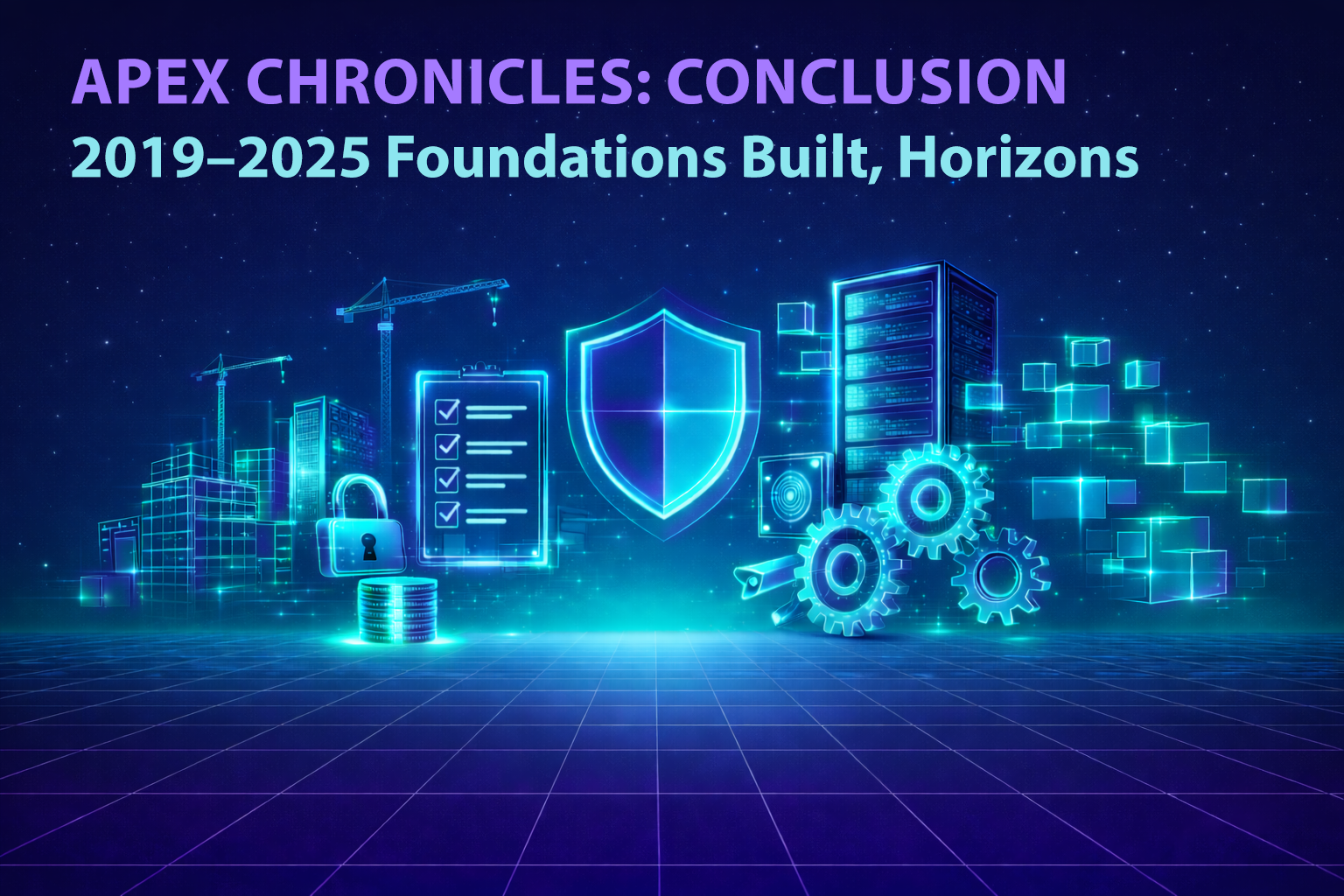 Looking back across seven years, the lesson is simple. Planning matters. No plan survives unchanged, but a good one creates enough structure to adapt. Progress often felt slow during legacy rebuilds and deep cleanup. In hindsight, those were the most productive years. They forced clarity, replaced improvisation with intent, and strengthened the architecture.
Real development is not linear. It bends, pivots, stretches, and sometimes fractures. What matters is forward motion. Setbacks become part of the design. Every challenge strengthened Apex Engine, shifting the focus from speed to survivability and coherence.
What emerged is a platform shaped deliberately rather than accidentally. Apex Engine exists because TGS Tech chose persistence over shortcuts, clarity over convenience, and long-term stability over temporary wins.
In technology, resilience is the ultimate feature. Everything else is just version control.