


How Apex Engine Aligns Execution, Feedback, and Long-Term Success
 Building a real-time platform is not just a technical challenge. It is an execution challenge. For Apex Engine, de-risking has never been about minimizing ambition. It has been about structuring the work so that each step validates the next, and so that progress is shared, tested, and adjusted before assumptions harden into constraints.
This approach benefits every stakeholder involved, from the internal team at TGS Tech, to past clients, early supporters, and current and future investors.
Avoiding the Throwaway Demo Trap
One of the most common risks in platform development is the creation of demos that look impressive but are disconnected from the actual product. These demos may succeed visually, but they fail to validate architecture, workflows, or real-world usage.
Apex Engine takes a different approach. The public demo is not treated as a disposable artifact. It is built directly on the same systems, workflows, and foundations that will power the MVP. What is demonstrated externally is not a parallel path, but a representative slice of the real platform. This ensures that effort invested in the demo compounds forward, rather than being rewritten or discarded.
Iteration as Risk Reduction
De-risking is not about freezing decisions early. It is about creating controlled feedback loops.
By exposing real systems to real users earlier, Apex Engine can validate assumptions around collaboration, usability, performance, and integration while adjustments are still inexpensive. Feedback from internal teams, former clients, and early supporters directly informs prioritization and refinement.
This iterative structure allows the platform to evolve with evidence rather than speculation. By involving clients and the community early in the process, iteration becomes a way to stay focused rather than expand unnecessarily. Real usage helps clarify what is actually needed versus what is merely possible, keeping development aligned with intent and preventing scope creep before it starts.
How Community Feedback Feeds the Roadmap
Community feedback is not treated as an afterthought or a marketing signal. It is incorporated directly into how roadmap decisions are evaluated and sequenced.
Feedback flows into development through several deliberate paths:
- Live demo usage and observation: How users interact with the demo reveals friction points, unclear workflows, and unexpected use cases that are difficult to surface through surveys alone.
- Direct client and partner conversations: Input from past clients and early adopters helps validate whether tools solve real problems or simply reflect internal assumptions.
- Support and access patterns: Where users ask for clarification, request access, or attempt workarounds provides insight into which systems need refinement or simplification.
- Internal alignment reviews: Feedback is reviewed alongside technical constraints, architectural dependencies, and long-term goals before changes are made.
Not all feedback results in immediate changes. Instead, it is categorized and evaluated based on impact, frequency, and alignment with the platform’s long-term direction. This prevents reactive development while still ensuring real-world usage informs priorities. In practice, it allows us to hit roadmap goals with intention, while leaving room for additional features or changes to be incorporated later in a clean and orderly way.
In practice, this means roadmap adjustments are intentional, documented, and traceable back to observed behavior rather than speculation.
Aligning Internal and External Incentives
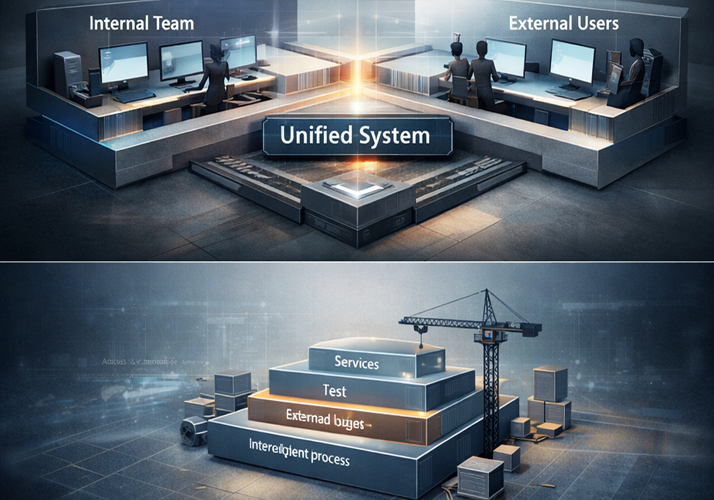 Another source of risk in complex projects is misalignment between internal development goals and external expectations.
Apex Engine intentionally aligns these incentives. The same systems used by the internal team are the systems evaluated by external users. The same workflows refined during demo preparation are the workflows that carry forward into the MVP.
This alignment reduces translation loss, shortens feedback cycles, and keeps development grounded in real use cases rather than abstract requirements.
Incremental Validation of Platform Economics
De-risking also applies beyond technology. As part of this process, early groundwork is being laid for the Apex Engine marketplace. Rather than launching a fully formed ecosystem all at once, the foundation is being validated incrementally with the help of other creators within the community. This allows us to get real-time feedback from those that will use the platform and help us align with the needs of both sellers and clients buying assets when it launches.
The marketplace is designed to support digital assets, plugins, and professional services. By establishing vendor onboarding flows, transaction mechanics, and access control early, Apex Engine can test monetization pathways alongside adoption, instead of bolting them on later.
This staged approach reduces financial risk while preserving long-term optionality.
Adjusting Early to Succeed
Apex Engine is not being built solely for short-term wins or quick gains. The focus is on mid- and long-term success, where durability, adaptability, and sustained value matter more than speed alone.
No platform reaches maturity without adjustments. The risk lies not in making changes, but in making them too late.
By structuring development around shared systems, live validation, and incremental exposure, Apex Engine creates room to adapt before decisions become expensive to unwind. This flexibility is intentional, and it is one of the most important safeguards against long-term failure.
A Long-Term View of Success
De-risking is not a single milestone. It is a continuous discipline that spans short-term, mid-term, and long-term goals, each carefully defined, designed, and tested.
For Apex Engine, success is not measured by speed alone, but by resilience. Each phase is structured to confirm that the platform can scale technically, operationally, and economically, with stakeholders learning alongside the system as it evolves.
This is how ambitious platforms are built to last.