


Apex Engine’s Legacy: OpenUSD, Real-Time Collaboration, and the Missing Layer
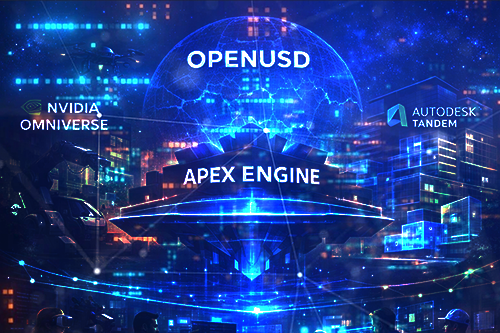 Real-time 3D platforms and digital twin technologies have slowly shifted from niche tools and game engines into core infrastructure powering simulation, collaboration, and AI-driven systems.
Two major industry efforts, NVIDIA’s Omniverse and OpenUSD ecosystem and Autodesk’s digital twin platform including Tandem, illustrate where the market is heading and how open standards are enabling cross-industry innovation. Yet there is still a missing piece: a real-time, live collaborative foundation that allows developers, programmers, engineers, and even clients to work inside the ecosystem to build, visualize, and test together in real time.
As Jensen Huang has emphasized in multiple keynotes, long-term success depends on fostering environments centered on co-design and co-development. Whether teams are working directly with AI models or building interactive worlds that integrate into the Omniverse ecosystem, collaboration must be foundational rather than incidental.
NVIDIA has consistently reinforced this philosophy through its platform strategy and partnerships with AWS, Alibaba, Autodesk, and a growing network of smaller companies. Across these efforts, the focus is clear: advancing AI as a practical tool while simultaneously evolving the real-time 3D and interactive technology space through shared standards and cooperative development models.
OpenUSD as the Common Language
At the center of this shift is OpenUSD, Universal Scene Description, an open standard originally developed by Pixar and now supported by the Alliance for OpenUSD. OpenUSD provides a structured way to represent complex 3D worlds, combining geometry, metadata, semantics, and relationships into a single, extensible scene graph.
More importantly, OpenUSD is not just a file format. It is a system for collaboration, composition, and change management across distributed teams. This makes it particularly well suited for digital twins, simulation environments, and AI-driven workflows where consistency, provenance, and scale matter as much as visual fidelity.
NVIDIA Omniverse and Physical AI
Built directly on OpenUSD, Omniverse demonstrates how real-time simulation, rendering, and AI systems can operate within a shared, synchronized environment. From robotics and autonomous systems to industrial simulation and synthetic data generation, Omniverse highlights the value of a common scene foundation paired with high-performance compute.
As physical AI systems grow more complex, the need for accurate simulation, deterministic state, and real-time feedback becomes critical. OpenUSD-based environments allow teams to validate behavior, train AI models, and test interactions long before deployment in the physical world.
Autodesk Tandem and Operational Digital Twins
Autodesk approaches the digital twin challenge from the perspective of the built environment and operations. Through Tandem, Autodesk focuses on creating accessible, data-rich digital twins that support facilities management, infrastructure monitoring, and long-term asset performance.
Autodesk Tandem emphasizes continuity between design data and operational insight. It helps organizations move beyond static models toward living systems that reflect real-world conditions. At the same time, it highlights an industry-wide need for more interactive and collaborative ways to evolve those systems over time.
The Missing Layer: Live, Real-Time Collaboration
Across Omniverse, Tandem, and broader OpenUSD adoption, the structural foundation is becoming clear. What remains underdeveloped is a live, real-time collaborative layer that supports simultaneous multi-user development with shared state, live iteration, and authoritative coordination.
This gap becomes more significant as digital twins grow more dynamic and AI systems are embedded deeper into real-time environments. Teams increasingly need to work together inside the same live system, not sequentially through exported assets or offline reviews, but collaboratively, with immediate feedback and shared context.
Without this layer, collaboration slows just as system complexity accelerates.
Where Apex Engine Fits
Apex Engine is being designed specifically to address this missing layer. By aligning with OpenUSD semantics and interoperability, Apex Engine can ingest and extend data from ecosystems like Omniverse and Tandem. More importantly, its architecture treats real-time collaboration as a core system rather than an add-on.
This includes:
- Real-time, multi-user collaboration as a foundational capability
- Deterministic state management and live synchronization
- Support for simulation and AI workflows without architectural friction
- A platform approach spanning development, testing, and live environments
Rather than replacing existing tools, Apex Engine is intended to complement them, enabling teams to work together inside shared, persistent systems.
Looking Forward
The convergence around OpenUSD, real-time simulation, and digital twins signals a broader shift in how interactive systems are built and maintained. Standards are aligning, ecosystems are opening, and expectations around collaboration and scale continue to rise.
The next phase of innovation will not come from isolated tools, but from stronger foundations that support co-design, co-development, and continuous iteration.
Apex Engine exists to help bridge that gap.